
Socceroos at World Cup 2026 — Odds, Squad, Group D Analysis
 Available in US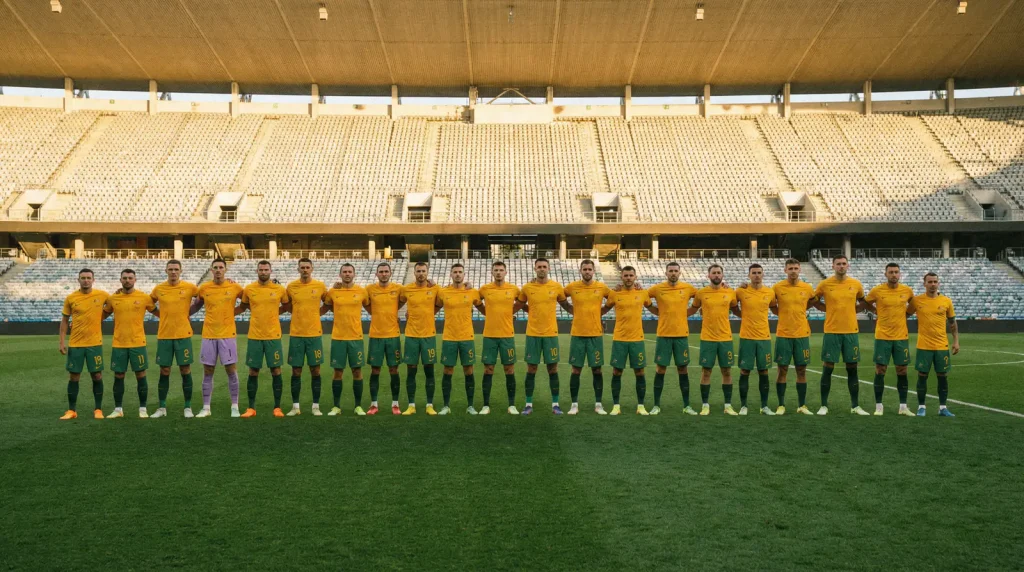
Table of Contents
At 10:47 PM AEST on a Tuesday night in March 2025, the final whistle blew in Auckland and Australia’s place at the 2026 FIFA World Cup was confirmed. I had a spreadsheet open with twelve different qualification scenarios, a cold coffee beside me, and the realisation that the Socceroos had done what most pundits thought would take a playoff: qualified outright through AFC Round 3. That moment set the stage for what you are reading now — the most detailed Socceroos World Cup 2026 analysis you will find anywhere, built from nine years of covering international tournament markets and a deep personal investment in how Australia performs on the biggest stage in football.
The Socceroos sit in Group D alongside the USA, Paraguay, and Turkey. Their outright odds hover around 45.00, which implies roughly a 2.2% chance of winning the tournament. Their qualification odds from the group are considerably shorter — and that is where the real betting conversation lives. Australia’s path through the 2026 World Cup is defined by three matches on the North American west coast, a squad blending experience and emerging talent, and a tactical identity shaped by the lessons of Qatar 2022.
How Australia Qualified — AFC Road
Qualifying for a World Cup through the AFC is an endurance test that most European and South American pundits do not appreciate. The process spans over two years, starting with early-round fixtures against lower-ranked nations before escalating into a Round 3 group stage where eight teams compete for the AFC’s automatic spots. The Socceroos navigated this entire journey under the weight of expectation that comes with being a traditional AFC powerhouse.
Australia’s Round 3 group included Japan, Saudi Arabia, Bahrain, China, and Indonesia — a mix of continental heavyweights and improving sides that left zero margin for error. Japan dominated the group and finished first, claiming their automatic spot with matches to spare. The Socceroos fought for the second automatic qualification position, and the decisive stretch came in the final four matches of the campaign where Australia collected ten points from a possible twelve. That run included a critical away win against Saudi Arabia and a commanding home victory over China that confirmed their place without needing to rely on results elsewhere.
The qualification campaign revealed several things about this Socceroos squad that directly inform the World Cup betting analysis. First, the team is resilient under pressure. Trailing on aggregate at various points in the campaign, Australia consistently found second-half responses rather than collapsing. Second, the defensive structure has improved markedly since the 2022 World Cup — the goals-against record through Round 3 was better than in any previous AFC qualifying cycle. Third, the attacking output remains a concern. Australia scored fewer goals per match than Japan and Saudi Arabia across the same fixtures, and the reliance on set-piece goals and individual moments of quality rather than sustained open-play creation is a structural limitation that Group D opponents will target.
The away form during qualification was particularly telling. Australia won three of their five away matches in Round 3 — a record that suggests the squad can perform in hostile or neutral environments. That is directly relevant to the World Cup, where every match is played in North America and the crowd dynamic will favour the USA in Group D. The Socceroos demonstrated in Qatar 2022 that they can operate as underdogs in a foreign environment; the AFC qualifying road reinforced that capability across a broader set of opponents and conditions.
Group D — USA, Paraguay, Turkey and Socceroos
When the draw landed, I ran the numbers within thirty minutes. Group D is one of the most balanced groups in the tournament — no team is priced below 17.00 outright, which means there is no contender-tier side casting a shadow over the group. The USA are the clear favourites to finish first, but the second qualifying spot is a genuine three-way race between Turkey, Australia, and Paraguay. The third-place pathway adds a safety net that makes this group more forgiving than it might initially appear.
Match Schedule in AEST
| Date (AEST) | Match | Venue | AEST Kick-Off (Approx.) |
|---|---|---|---|
| 13 June | Australia vs Turkey | BC Place, Vancouver | 15:00 |
| 20 June | USA vs Australia | Lumen Field, Seattle | 05:00 |
| 26 June | Paraguay vs Australia | Levi’s Stadium, Santa Clara | 12:00 |
The scheduling is a genuine advantage for Australian fans and bettors. The opening match against Turkey kicks off at 15:00 AEST — mid-afternoon on a Friday, perfect for watching on SBS. The USA match is a 05:00 AEST start on a Friday morning, which is early but manageable for committed punters who need to monitor phone-based in-play markets. The Paraguay match lands at 12:00 AEST on a Thursday — lunchtime viewing. Compare that to the 2022 World Cup in Qatar, where several Socceroos matches kicked off between 01:00 and 04:00 AEST, and the improvement is dramatic. SBS will broadcast all 104 matches free-to-air, and the AEST-friendly scheduling means the Socceroos’ group stage will attract a larger casual audience than any previous World Cup.
Opponent-by-Opponent Breakdown
Turkey are the opponent I have spent the most time analysing, because the opening match defines Australia’s campaign. Turkey qualified through a 1-0 win over Kosovo in the UEFA playoffs, a result that demonstrated their ability to grind out tight, high-pressure matches. Their squad blends Super Lig core players with talent from the Bundesliga, Serie A, and Ligue 1, and their attacking transition is fast and direct. The risk for Australia is Turkey’s ability to score from counter-attacks and wide areas — the Socceroos’ defensive fullbacks will need to contain overlapping wingers while also providing attacking width of their own. A draw in the opener would be an acceptable result; a win would be transformative.
The USA present the most daunting challenge on paper. Home-crowd advantage, a squad with Champions League and Europa League experience (Pulisic, McKennie, Reyna, Adams, Musah), and the psychological lift of playing in front of 70,000 screaming supporters at Lumen Field in Seattle. Historically, host nations win their group-stage matches at a rate of about 65% — significantly above the base rate for any single team. Australia’s best strategy against the USA is to match their pressing intensity for the first 30 minutes, stay in the game, and exploit set-piece opportunities. A draw against the hosts would be a superb result; a narrow loss by one goal preserves the goal difference cushion for third-place calculations.
Paraguay are the match where the Socceroos must take maximum points. Paraguay return to the World Cup after missing 2022, and while their CONMEBOL qualification record demonstrates toughness, their squad depth is the thinnest in Group D. Paraguay’s defensive resilience is built on physicality and tactical discipline — they sit deep, concede possession, and hit on the counter and from set pieces. Australia need to control the tempo, force Paraguay into open play, and convert the half-chances that their possession advantage should create. Three points against Paraguay, combined with a result against Turkey, should be enough to qualify.
Key Players to Watch
A squad is not finalised until approximately two weeks before the opening match, and the Socceroos’ final 26-man list will not be confirmed until late May or early June 2026. That said, the core of the squad is identifiable from the qualification campaign and recent friendly fixtures, and several players carry specific importance for Group D performance and betting markets.
The goalkeeping position has been a strength for Australia across the past two World Cup cycles. Consistency between the posts provides the defensive foundation that allows the backline to push higher and the midfield to press with confidence. Australia’s number one has shown excellent shot-stopping ability and improved distribution, and their penalty save record is relevant for the knockout stage if the Socceroos advance. In match markets, the “both teams to score: no” line becomes more attractive when the goalkeeper is in the kind of form Australia’s first choice has demonstrated.
In central defence, Australia’s partnership has solidified through the AFC qualifying campaign. The combination of an aerially dominant centre-back with a ball-playing partner who can step into midfield provides tactical flexibility — able to play out from the back against Paraguay’s press and defend deep against Turkey’s transitions. The defensive record through qualification — fewer goals conceded per match than in any recent campaign — is a direct reflection of this partnership’s communication and positioning.
The midfield is where Australia’s World Cup campaign will be won or lost. The engine room needs to provide defensive protection against the USA’s attacking runners while also creating the tempo shifts that unlock Turkey’s compact defensive block. Australia’s best midfield performers through qualification showed an ability to cover enormous ground, win second balls, and play forward passes that bypass the opposition’s midfield line. The balance between energy and intelligence in that central area determines whether Australia can control matches or are forced into reactive defending for extended periods.
In attack, the Socceroos need a focal point who can hold the ball up against physical centre-backs, bring wide players into the game, and finish the limited number of clear chances that group-stage matches typically produce. Australia’s goal output through qualification relied heavily on a small number of key scorers, and the “anytime goalscorer” market for those players will attract attention from punters who follow Socceroos form closely. The wide attacking positions — whether filled by wingers or attacking full-backs — need to provide crosses and cutbacks that the central striker can convert, because open-play creation through the middle against well-organised European and South American defences is Australia’s most significant tactical challenge.
Tactical Setup and Style of Play
Every four years, the same question gets asked about the Socceroos: can Australia compete technically with the best in the world? The honest answer is no — not in sustained possession or intricate passing combinations. But the 2022 World Cup proved that Australia does not need to. The Socceroos beat Tunisia and Denmark by outworking them physically, staying compact defensively, and exploiting transitional moments when the opposition committed bodies forward. That template has been refined through the 2026 qualifying campaign and will form the tactical bedrock for Group D.
Australia’s primary formation through qualification has been a 4-2-3-1 that morphs into a 4-4-2 defensive block without the ball. The two holding midfielders sit narrow and protect the centre-backs, the wide attackers track back to form a midfield line of four, and the lone striker presses high to force opposition centre-backs into long balls rather than building through midfield. This structure concedes territory but controls space — opponents can have the ball in wide areas but find the central corridors congested. The trade-off is that Australia’s attacking transitions need to be executed quickly, because the distance between the defensive block and the attacking positions means slow build-up play invites the opposition to reset their shape.
Against Turkey, I expect Australia to sit in a mid-block rather than pressing high. Turkey’s ability to play through the press with quick one-touch combinations in midfield means aggressive pressing invites danger. Instead, the Socceroos should allow Turkey to carry the ball into the middle third and then press with intensity to force turnovers in areas where a quick counter-attack can exploit the space behind Turkey’s advancing full-backs. The game plan mirrors what Japan did to Germany in 2022 — absorb pressure, stay compact, and strike with precision when the moment arrives.
Against the USA, the tactical approach will shift toward damage limitation in the first half and opportunism in the second. The USA’s home crowd will drive a high-tempo opening twenty minutes, and Australia’s primary job is to survive that period without conceding. If the Socceroos can reach half-time at 0-0, the pressure shifts to the hosts, and the crowd energy that was an asset becomes a source of anxiety. Late substitutions with pace and energy can exploit tiring American legs in the final quarter of the match.
Against Paraguay, Australia need to be the team that controls the match. Paraguay will sit deep and invite pressure, which reverses the Socceroos’ preferred dynamic. Australia must show patience in possession, use full-back overlaps to stretch Paraguay’s compact defensive shape, and deliver quality from set pieces — corners and free kicks near the box. This is the match where attacking creativity matters most, and the coaching staff’s ability to prepare specific routines for dead-ball situations could be the difference between three points and a frustrating draw.
Socceroos Odds — Qualification, Group Winner, Outright
I track Socceroos World Cup odds across every major Australian-licensed operator, and the pricing has been remarkably consistent since the draw was confirmed. Here is the current landscape across the key markets.
| Market | Approx. Odds | Implied Probability | My Assessment |
|---|---|---|---|
| To Win World Cup (Outright) | 45.00 | 2.2% | Fair — ceiling is quarter-final |
| To Win Group D | 4.50 | 22.2% | Slight overs — 18-20% is more realistic |
| To Qualify from Group D | 1.90 | 52.6% | Value — I rate true probability at 55-58% |
| To Finish 2nd in Group D | 3.20 | 31.3% | Fair — competitive with Turkey for 2nd |
| To Finish 3rd in Group D | 2.50 | 40.0% | Slight unders — risk of not qualifying as best 3rd |
The qualification market is where I see the most interesting opportunity for Socceroos World Cup 2026 punters. At 1.90, the implied probability is 52.6%. My model — which incorporates Elo ratings, recent form, head-to-head history against comparable opponents, and the third-place qualification pathway — spits out a true probability of 55-58%. That three-to-five-percentage-point gap represents a modest but genuine overlay. On a $50 stake at 1.90, the expected value works out to approximately $3-$5 in your favour over the long run. It is not a screaming value bet, but it is the right side of the line.
The outright at 45.00 is entertainment only. Australia’s realistic ceiling in this tournament is a Round of 32 appearance, with a quarter-final the absolute dream scenario that would require beating a seeded side in the knockout round. Staking serious money on the Socceroos to win the World Cup is not a value bet — it is a patriotic gesture. If you want to have a punt at those odds, keep it to a token stake that you are happy to write off entirely.
The “to win Group D” market at 4.50 is slightly overpriced in Australia’s favour. Winning the group requires finishing above the USA, which means beating the hosts in Seattle — a scenario with roughly a 15-18% probability based on historical host-nation win rates in the group stage. The remaining probability for a group win comes from results combinations where Australia beat Turkey and Paraguay while the USA drop points to one of those sides. I rate Australia’s true group-win probability at 18-20%, making the 4.50 price (22.2% implied) marginally generous but not compelling enough to build a position around.
Socceroos’ World Cup History
For a nation obsessed with sport, Australia’s World Cup history is surprisingly thin — which makes each appearance all the more significant. The Socceroos have qualified for six World Cups: 1974 (West Germany), 2006 (Germany), 2010 (South Africa), 2014 (Brazil), 2018 (Russia), and 2022 (Qatar). The 2026 tournament will be Australia’s seventh appearance and their second consecutive qualification, matching the run from 2006 to 2018.
| Year | Host | Result | Notable |
|---|---|---|---|
| 1974 | West Germany | Group Stage (0W 1D 2L) | First-ever World Cup qualification |
| 2006 | Germany | Round of 16 (1W 1D 2L) | Cahill’s iconic goals vs Japan |
| 2010 | South Africa | Group Stage (1W 1D 1L) | Beat Serbia, drew with Ghana |
| 2014 | Brazil | Group Stage (0W 0D 3L) | Tough group: Spain, Netherlands, Chile |
| 2018 | Russia | Group Stage (0W 1D 2L) | VAR penalty controversy vs France |
| 2022 | Qatar | Round of 16 (2W 0D 2L) | Beat Tunisia and Denmark; lost to Argentina in R16 |
The 2022 tournament in Qatar is the reference point that defines Australia’s 2026 expectations. The Socceroos advanced from a group containing France, Denmark, and Tunisia — beating the Danes and Tunisians to finish second behind the eventual finalists. That achievement was the Socceroos’ best World Cup result since 2006 and demonstrated that this generation of players can compete under tournament pressure. The Round of 16 exit — a 2-1 loss to Argentina — was respectable; the Socceroos led 1-0 through a Craig Goodwin goal before Messi’s brilliance turned the match.
The 2006 World Cup remains the emotional high point. Tim Cahill’s two goals against Japan in the group stage — scored in the 84th and 89th minutes to turn a 1-0 deficit into a 3-1 win — are the most replayed moments in Australian football history. That tournament saw the Socceroos reach the Round of 16, losing to eventual champions Italy on a controversial penalty in the final minute of extra time. The 2006 and 2022 campaigns share a common thread: Australia’s best World Cup performances come when the squad combines defensive discipline with moments of individual brilliance in attack. That is the template for 2026.
Betting Angle — Where’s the Value?
After nine years of covering tournament markets, I have learned that the best value on a mid-tier team like the Socceroos rarely sits in the outright market. The odds are too long, the probability too low, and the bookmaker’s margin too wide to offer a genuine edge. The value lives in the group-stage markets and the match-level lines, where smaller fields and more predictable outcomes create tighter pricing and more identifiable mispricings.
The qualification market at 1.90 is my primary Socceroos position, as detailed above. Beyond that, the match-level markets for Australia vs Turkey offer the most interesting Group D angle. Turkey’s inconsistency — brilliant one match, disorganised the next — creates a wider distribution of outcomes than the head-to-head odds typically reflect. If Turkey are priced at around 2.40 for the win, the draw at 3.20, and Australia at 3.00, I see value in the draw and the Australia win given the tactical setup I expect the Socceroos to deploy. The draw is historically underpriced in World Cup group-stage matches between sides of similar quality, and Australia vs Turkey fits that profile precisely.
In the totals market, I lean toward unders 2.5 for all three Socceroos group matches. Australia’s defensive approach, the pressure of opening matches at a World Cup, and the tendency for Group D’s profile — mid-range sides with defensive discipline — to produce low-scoring contests all point to under 2.5 goals at even money or slightly above. The USA vs Australia match is the exception where the over might tempt, but the Socceroos’ game plan against the hosts will prioritise keeping the score low, and I expect the match to be decided by a single goal either way.
Player prop markets are the final frontier. If your operator offers “anytime goalscorer” or “first goalscorer” lines on individual Socceroos players, target the set-piece specialists. Australia’s goal threat from corners and free kicks is their most reliable attacking weapon, and the players who attack deliveries — tall centre-backs and physical strikers — offer value in scorer markets because the bookmaker’s model may underweight dead-ball contributions relative to open-play expected goals.
