
Lumen Field — World Cup 2026 Venue: USA vs Australia Stadium
 Available in US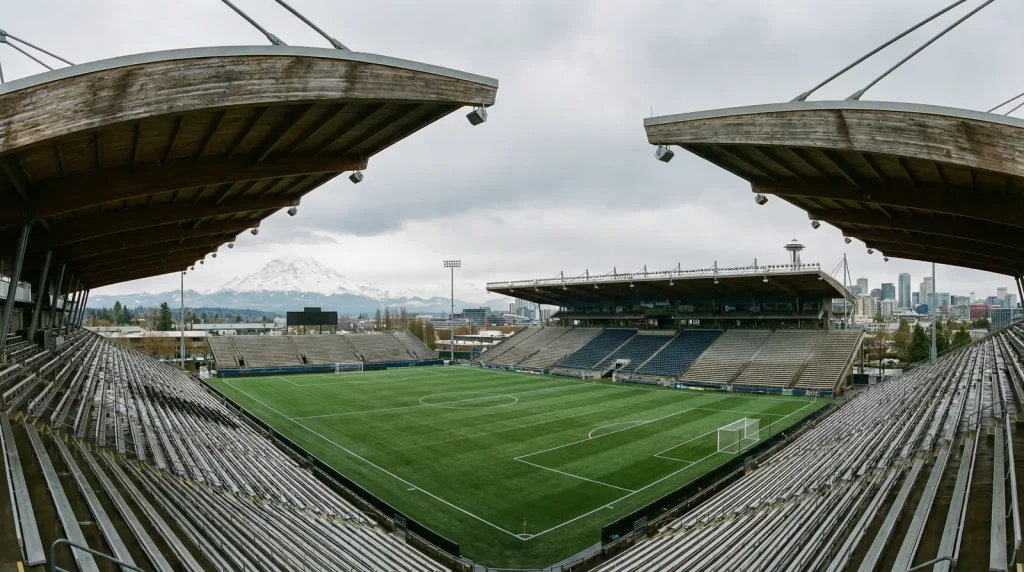
Table of Contents
Seattle’s Lumen Field holds a reputation that travels far beyond the Pacific Northwest. NFL visiting teams have recorded crowd noise exceeding 137 decibels inside this stadium — louder than a jet engine at takeoff and enough to trigger seismic monitoring equipment at the University of Washington a kilometre away. On 19 June 2026, the Socceroos walk into that wall of sound to face the United States in a World Cup 2026 Group D match that could define Australia’s tournament. Understanding Lumen Field — its acoustic design, its pitch characteristics, its location — is not just trivia for stadium nerds. It is essential intelligence for anyone placing a bet on this fixture.
Stadium at a Glance
Lumen Field opened in 2002 as Seahawks Stadium, and the architectural team made a deliberate decision that would shape the venue’s identity forever: they partially enclosed the north and south ends with cantilevered roof sections that funnel crowd noise directly onto the playing surface. The result is an acoustic amplifier disguised as a sports venue, where 69,000 fans generate the decibel levels of a stadium twice that size.
| Detail | Information |
|---|---|
| Full Name | Lumen Field |
| Location | Seattle, Washington State |
| Opened | July 2002 |
| Construction Cost | US$430 million |
| Capacity (FIFA configuration) | Approximately 69,000 |
| Surface | Natural grass (FieldTurf replaced for World Cup) |
| Roof | Partial cantilevered canopies (open-air) |
| Primary Tenants | Seattle Seahawks (NFL), Seattle Sounders FC (MLS) |
| Notable Record | Loudest crowd noise in a sports stadium: 137.6 dB (2014) |
The Sounders’ presence as a co-tenant is significant for the World Cup. Seattle has one of the strongest soccer cultures in the United States — the Sounders regularly draw 40,000+ to MLS matches and won the MLS Cup in 2016 and 2019. The city’s fanbase understands football, appreciates tactical nuance, and creates an atmosphere that genuinely intimidates visiting teams. When the USA host Australia at Lumen Field, the crowd will not be casual spectators — they will be invested, knowledgeable football fans driving the energy for 90 minutes.
Seattle’s June weather averages 18-22 degrees Celsius with long daylight hours (sunrise at 05:15, sunset at 21:10). The Pacific Northwest is notoriously overcast, but June is actually one of the driest months, with an average of 37mm of rainfall spread across roughly seven rain days. Conditions at Lumen Field during the World Cup should be close to ideal for football — mild temperatures, minimal wind inside the partially enclosed bowl, and a natural grass surface installed specifically for FIFA’s requirements. The partial roof canopies protect roughly 70% of spectators from any rain while leaving the pitch exposed, meaning players could face light drizzle while the crowd stays dry and loud.
USA vs Australia — The Big One in Seattle
I have a rule when analysing World Cup fixtures: identify the match where one team’s emotional investment massively exceeds the other’s, and lean towards that side if the odds are close. USA vs Australia at Lumen Field on 19 June is a textbook case. The Americans are playing a World Cup match on home soil, in a city that lives and breathes football, against a Socceroos side that the US media will frame as a winnable-but-dangerous opponent. The crowd energy, the patriotic fervour of a nation hosting its first World Cup since 1994, and the tactical setup that Gregg Berhalter or his successor will deploy — everything points to an American side operating at maximum intensity.
The Socceroos’ challenge is to survive that initial onslaught. In Qatar 2022, Australia faced France in their opening match and absorbed sustained pressure before conceding a goal in the ninth minute — then settled into the match and competed for the remaining 80 minutes. Against the USA at Lumen Field, the opening 15 minutes will be critical. If Australia can weather the early storm, keep the score level, and force the Americans to become impatient, the dynamic shifts. A compact Socceroos defence frustrating a home crowd that expects goals creates anxiety, and anxiety leads to mistakes.
The head-to-head market sits at approximately USA 1.55, Draw 3.80, Australia 6.50. The draw at 3.80 is the play I favour for this fixture. Australia’s tournament record against higher-ranked opponents in World Cup group matches shows a pattern of competitive, low-scoring defeats and surprise draws — the 1-1 against Denmark in 2022 being the template. The Socceroos will not try to outplay the USA; they will try to frustrate them. If that approach yields a point, the 3.80 price delivers strong value against what I assess as a 28-30% probability of a draw.
The total goals market reinforces this view. Under 2.5 goals in USA vs Australia at Lumen Field sits around 1.70, and I rate the probability of two goals or fewer at approximately 55-60%. The Socceroos’ defensive discipline in tournament football, combined with a USA side that may overthink against an opponent they are expected to beat comfortably, creates the conditions for a 1-0 or 1-1 result. Over 2.5 at 2.10 requires the USA to break down a side specifically set up to deny them space — possible but less likely than the market implies.
All World Cup Matches at Lumen Field
Lumen Field hosts multiple group-stage fixtures beyond the USA vs Australia clash, plus at least one Round of 32 match. The venue’s 69,000 capacity and established infrastructure for international football (it hosted Copa America 2024 matches and regular USMNT fixtures) make it one of FIFA’s preferred Pacific Northwest locations. Group D’s final-matchday fixture between USA and Turkey is also scheduled for Lumen Field on 25 June, creating a two-week window where the stadium is the epicentre of Group D action.
The scheduling means Lumen Field effectively becomes the USA’s home ground for the group stage — two of the Americans’ three group matches take place here, giving them a familiarity advantage that no other team in Group D can match. For betting purposes, this home-ground effect is already priced into the USA’s group odds, but the specific venue factor at Lumen Field — the noise, the crowd knowledge, the pitch conditions — adds a layer of home advantage that generic “host nation” modelling may underestimate.
Non-Group-D fixtures at Lumen Field will draw from the broader Pacific Northwest cluster of matches. Seattle’s time zone (Pacific, UTC-7 during summer) aligns with Vancouver’s, meaning any match at Lumen Field produces AEST conversions identical to BC Place — afternoon local kick-offs translate to 05:00-08:00 AEST, while evening fixtures land between 11:00 and 12:00 AEST. Australian punters can apply the same viewing and betting schedule to both venues.
Seattle — Travel Info for Australian Fans
Seattle is not a city that most Australians have on their travel radar, but it should be. The flight from Sydney to Seattle operates via connections through Los Angeles, San Francisco, or Vancouver — total travel time runs 16-18 hours depending on the layover. There are no direct flights from Australia to Seattle at the time of writing, though airlines may add seasonal services for the World Cup. The most efficient routing for Australian fans attending both the Vancouver opener (BC Place) and the Seattle match (Lumen Field) is to fly into Vancouver, attend the 13 June fixture, then drive or take the Amtrak Cascades train south to Seattle — a 230-kilometre journey that takes approximately 3.5 hours by car or 4 hours by rail along one of the most scenic corridors in North America.
Lumen Field sits in Seattle’s SoDo district, south of downtown, and is accessible via the Link Light Rail system — the Stadium station is a 2-minute walk from the gates. Public transport in Seattle is functional and improving, with light rail connections to the airport (Sea-Tac) taking approximately 40 minutes. Match-day transport is well-practised thanks to years of Seahawks and Sounders events, and the city’s walkability means most downtown hotels are within a 20-30 minute walk of the stadium.
Accommodation during the World Cup will range from A$200 to A$450 per night for mid-range hotels in downtown Seattle or the Capitol Hill neighbourhood. The Pioneer Square and International District areas, closest to Lumen Field, have limited hotel stock but abundant restaurants and bars that will serve as pre-match gathering points. Seattle’s craft beer scene — over 150 breweries in the metropolitan area — will provide Australian fans with a familiar pub-culture experience that feels closer to home than most American cities.
Kick-Off Times in AEST
| Local Kick-Off (PT) | AEST Equivalent | Key Fixture |
|---|---|---|
| 12:00 (noon) | 05:00 (+1 day) | Group stage |
| 15:00 (3pm) | 08:00 (+1 day) | USA vs Australia (19 Jun) — approx. |
| 18:00 (6pm) | 11:00 (+1 day) | Knockout round |
| 19:00 (7pm) | 12:00 (+1 day) | Final matchday / knockout |
The USA vs Australia match on 19 June kicks off at approximately 15:00 PT local time, translating to around 05:00 AEST on 20 June. That is an early-morning start for Australian viewers — a step down from the afternoon slot of the Turkey opener at BC Place but still manageable for punters willing to set an alarm. SBS will carry the broadcast live, and the pre-dawn timing in Australia means the betting markets will be thinner than for afternoon fixtures, potentially creating small pricing inefficiencies for sharp punters who are awake and watching.
