
World Cup 2026 FAQ — Everything You Need to Know
 Available in US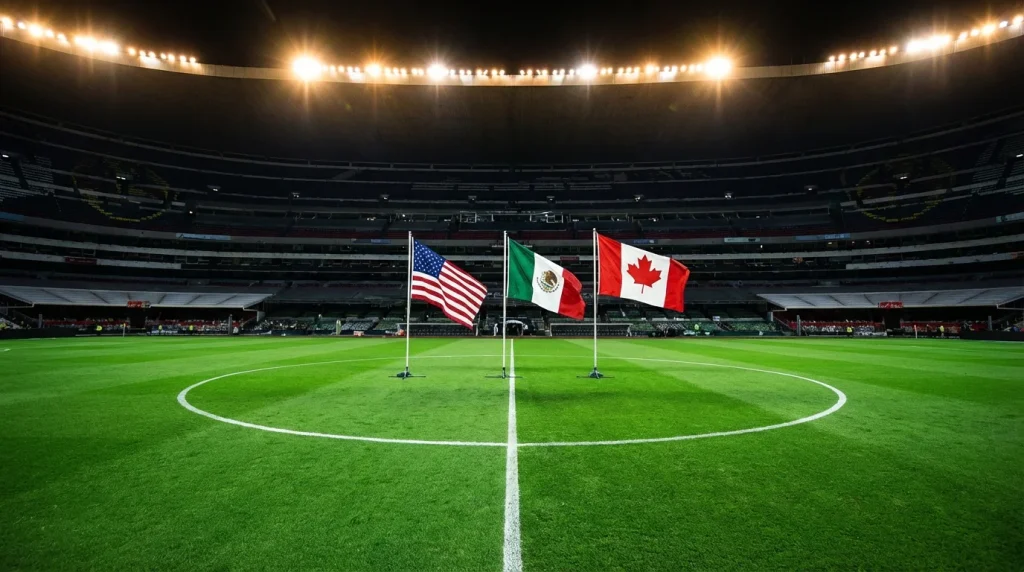
Table of Contents
Every World Cup cycle brings the same wave of questions from punters who want the facts before they commit their money. I get it — the 2026 tournament is the most complex in FIFA history, with 48 teams, three host countries, 16 venues across two continents, and a new group-stage format that changes how qualification works. Whether you are a Socceroos diehard who has been counting down since Qatar or a casual fan who only tunes in for the World Cup, this FAQ covers the essential questions about the 2026 FIFA World Cup with answers built for Australian punters.
Tournament Basics
When does the 2026 World Cup start and finish?
The tournament runs from 11 June to 19 July 2026 — a span of 39 days. The opening match is Mexico vs South Africa at Estadio Azteca in Mexico City on 11 June. The final takes place at MetLife Stadium in East Rutherford, New Jersey, on 19 July. The group stage runs from 11 to 27 June, the Round of 32 from 28 June to 2 July, the Round of 16 from 4 to 7 July, the quarter-finals on 9 and 10 July, the semi-finals on 14 and 15 July, and the final on 19 July.How many teams are in the 2026 World Cup?
Forty-eight teams compete at the 2026 FIFA World Cup, up from 32 at the 2022 tournament in Qatar. The expansion adds 16 additional nations, many of which are competing at a World Cup for the first time or returning after long absences. The 48 teams are drawn into 12 groups of four, and 104 matches are played across 39 days — 30 more matches than the previous format.How does the group stage work with 48 teams?
The 48 teams are divided into 12 groups (A through L), each containing four teams. Every team plays three group matches — one against each other team in their group. The top two teams from each group (24 teams) qualify automatically for the Round of 32. The eight best third-placed teams from the twelve groups also advance, bringing the total to 32 teams in the knockout stage. Points are awarded as three for a win, one for a draw, and zero for a loss. Tiebreakers follow the standard FIFA protocol: goal difference, goals scored, head-to-head record, then fair play points.Which countries are hosting the 2026 World Cup?
Three countries share hosting duties: the United States (11 stadiums, hosting 78 of the 104 matches including the semi-finals and final), Mexico (3 stadiums, 13 matches including the opening match), and Canada (2 stadiums, 13 matches). It is the first World Cup held across three nations and the first in North America since the USA hosted in 1994. The 16 venues span from Vancouver on the Pacific coast to Boston and Miami on the Atlantic, with Mexico City, Monterrey, and Guadalajara in Mexico and Toronto in eastern Canada.What is the knockout format after the group stage?
The knockout stage begins with a Round of 32 featuring 32 teams — the 24 automatic qualifiers (top two per group) plus the eight best third-placed sides. Matches are single-elimination: if the score is level after 90 minutes, 30 minutes of extra time are played, followed by a penalty shootout if necessary. The Round of 32 leads to the Round of 16, then quarter-finals, semi-finals, a third-place playoff, and the final. The entire knockout stage runs from 28 June to 19 July.How are the eight best third-placed teams determined?
After the group stage, the twelve third-placed teams are ranked using the same criteria applied within groups: points, goal difference, goals scored, and then fair play record. The top eight advance to the Round of 32. In practice, a third-placed team with four or more points has historically been very likely to qualify. Even three points with a neutral goal difference may be sufficient, depending on results across other groups. This safety net makes the 2026 group stage more forgiving than previous formats — a single defeat does not necessarily mean elimination.
Betting Questions
Is it legal to bet on the World Cup in Australia?
Online sports betting is fully legal in Australia when using a bookmaker licensed by an Australian state or territory. The industry is regulated under the Interactive Gambling Act 2001 (amended 2016) at the federal level, with the Australian Communications and Media Authority (ACMA) providing oversight. Each state and territory has its own licensing body — for example, Liquor & Gaming NSW in New South Wales and the VGCCC in Victoria. All licensed Australian bookmakers are required to verify identity, enforce responsible gambling obligations, and participate in the BetStop national self-exclusion register.Can I place in-play bets on World Cup matches online?
No. In-play (live) betting on sporting events is prohibited online in Australia under the Interactive Gambling Act. You can only place in-play bets by telephone — calling your bookmaker’s phone betting line during the match. This restriction applies to all online platforms and apps operating under Australian licences. It is one of the most significant differences between Australian betting and markets in the UK, Europe, or the USA, where in-play online betting is legal and widely available. If your betting strategy relies on live market movements during matches, you will need to use the phone betting option.What odds format is used in Australia?
Australian bookmakers display odds in decimal format as standard. Decimal odds represent the total return on a one-dollar stake, including the original stake. Odds of 3.50 mean a $10 bet returns $35 total ($25 profit plus the $10 stake). To convert decimal odds to implied probability, divide 1 by the odds: 1 / 3.50 = 28.6%. Some platforms offer the option to display fractional (British) or American (moneyline) odds, but decimal is the default across the Australian market.Can I use a credit card or cryptocurrency to bet?
No. Since June 2024, Australian regulations prohibit the use of credit cards and cryptocurrency for online sports betting. Permitted payment methods include debit cards, bank transfers, and approved e-wallets. This change was introduced to reduce gambling-related financial harm and applies to all licensed Australian operators. If you attempt to deposit using a credit card, the transaction will be declined by the operator’s payment system.What is BetStop?
BetStop is the Australian National Self-Exclusion Register, launched in August 2023. It allows any person to voluntarily exclude themselves from all licensed Australian wagering services for a minimum period of three months, with options extending up to a lifetime ban. Once registered, all licensed operators are legally required to close your accounts and refuse any new account applications. BetStop is a free service operated by the ACMA and can be accessed online at the BetStop website. It covers online, phone, and in-person betting with licensed operators.What World Cup betting markets are available?
Australian bookmakers offer a comprehensive range of World Cup markets. Outright markets include tournament winner, Golden Boot (top scorer), reaching the final, and reaching the semi-finals. Group-stage markets cover group winner, to qualify, exact group finishing order, and group total goals. Match-level markets include head-to-head (1X2), handicap (line betting), total goals (overs/unders), both teams to score, correct score, first goalscorer, and various player props (shots, cards, corners). Multi-bet options allow you to combine selections across matches and markets into a single wager.
Australia-Specific
Are the Socceroos in the 2026 World Cup?
Yes. Australia qualified for the 2026 FIFA World Cup through the AFC (Asian Football Confederation) Round 3 qualification pathway. The Socceroos are drawn in Group D alongside the United States (hosts), Paraguay, and Turkey. Australia’s three group matches are all on the west coast of North America: vs Turkey at BC Place in Vancouver (13 June), vs USA at Lumen Field in Seattle (19 June), and vs Paraguay at Levi’s Stadium in Santa Clara (25 June). This is Australia’s seventh World Cup appearance overall and their second consecutive tournament after reaching the round of 16 in Qatar 2022.Where can I watch the World Cup in Australia?
SBS holds the exclusive free-to-air broadcast rights for all 104 matches of the 2026 FIFA World Cup in Australia. Every match will be available live on SBS television channels and via the SBS On Demand streaming platform. No pay-TV subscription is required to watch any fixture, including the Socceroos’ group matches, knockout rounds, and the final. SBS On Demand is free to access and available on smart TVs, tablets, phones, and web browsers. This continues SBS’s long-standing role as Australia’s home of World Cup football.What are the Socceroos’ odds to qualify from Group D?
At the time of writing, the Socceroos’ odds to qualify from Group D (top two finish) sit at approximately 1.85, implying a 54% probability. When the best-third-place pathway is included, the overall chance of advancing to the knockout stage rises to approximately 60-67% based on current market pricing. Australia are the third favourites in the group behind the USA (1.20 to qualify) and Turkey (1.75 to qualify), with Paraguay the outsiders at 2.40. The expanded 48-team format with eight best-third spots from twelve groups significantly improves the Socceroos’ chances compared to older World Cup formats.What time are the Socceroos’ World Cup matches in AEST?
All three Socceroos group matches are on the west coast of North America, producing the following approximate AEST kick-off times: Australia vs Turkey on 13 June at 15:00 AEST (mid-afternoon — ideal for live viewing); USA vs Australia on 20 June at 05:00 AEST (early morning — an alarm-clock start); Paraguay vs Australia on 26 June at 12:00 AEST (midday — comfortable viewing over lunch). These times are significantly more viewer-friendly than European tournament schedules, where Australian kick-offs typically fall between 01:00 and 05:00 AEST.
Schedule & Venues
How many stadiums are used at the 2026 World Cup?
Sixteen stadiums across three countries host the 104 matches. The United States provides eleven venues: MetLife Stadium (East Rutherford/New York), SoFi Stadium (Los Angeles), Hard Rock Stadium (Miami), AT&T Stadium (Dallas), NRG Stadium (Houston), Mercedes-Benz Stadium (Atlanta), Lumen Field (Seattle), Levi’s Stadium (San Francisco Bay Area), Lincoln Financial Field (Philadelphia), Gillette Stadium (Boston), and GEHA Field at Arrowhead Stadium (Kansas City). Mexico contributes three venues: Estadio Azteca (Mexico City), Estadio BBVA (Monterrey), and Estadio Akron (Guadalajara). Canada provides two: BMO Field (Toronto) and BC Place (Vancouver).Where is the World Cup 2026 final?
The final is at MetLife Stadium in East Rutherford, New Jersey, on 19 July 2026. MetLife has a FIFA-configuration capacity of approximately 82,500 and sits 12 kilometres from Manhattan. The kick-off time is 19:00 ET (local), which translates to 09:00 AEST on Sunday 20 July — a prime viewing window for Australian audiences. MetLife also hosts a semi-final on 15 July along with group-stage and earlier knockout matches.What is the time difference between Australia and the World Cup venues?
The 2026 World Cup spans three North American time zones during daylight saving time. Eastern Daylight Time (EDT, UTC-4) covers venues in New York, Miami, Atlanta, Philadelphia, Boston, and Toronto — these are 14 hours behind AEST. Central Daylight Time (CDT, UTC-5) covers Dallas, Houston, Kansas City, Mexico City, Monterrey, and Guadalajara — 15 hours behind AEST. Pacific Daylight Time (PDT, UTC-7) covers Los Angeles, Seattle, San Francisco, and Vancouver — 17 hours behind AEST. For Australian viewers, west-coast matches produce the most comfortable AEST times (afternoon to midday), while east-coast matches fall in the early-morning AEST window.Are all matches on free-to-air TV in Australia?
Yes. SBS holds exclusive free-to-air rights to all 104 matches of the 2026 FIFA World Cup. Every group-stage fixture, knockout match, and the final will be broadcast live on SBS television and streamed free via SBS On Demand. There is no requirement for a Foxtel, Stan Sport, Optus Sport, or any other subscription to access World Cup coverage in Australia. SBS will also produce pre-match analysis, half-time coverage, post-match discussion, and highlight packages across its broadcast and digital platforms.
The 2026 FIFA World Cup is the most expansive edition in the tournament’s 96-year history, and for Australian punters, the combination of AEST-friendly kick-off times, free SBS coverage, and the Socceroos’ placement in a competitive but winnable Group D creates a tournament experience that is more accessible than any World Cup in recent memory. The expanded format rewards preparation — understanding the rules, the schedule, and the market landscape before the first ball is kicked on 11 June gives you an edge over punters who are still figuring out the basics when the group stage is already underway.
