
Morocco at World Cup 2026 — 2022 Heroes Return, Odds and Group C
 Available in US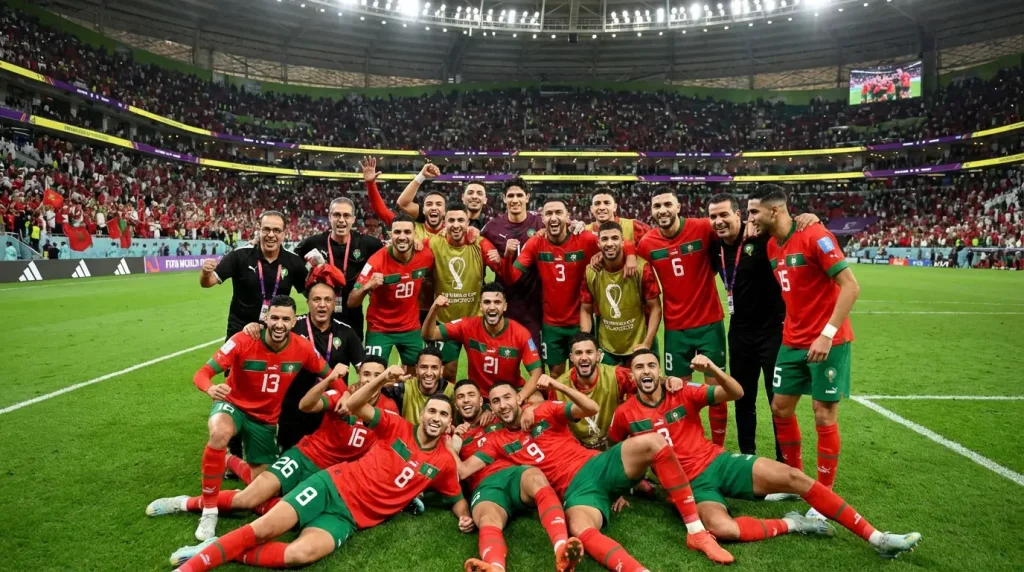
Table of Contents
Walid Regragui stood on the touchline in Al Bayt Stadium on 14 December 2022 and watched his side fall 2-0 to France in the World Cup semi-final. Morocco had already beaten Belgium, Spain, and Portugal to become the first African nation to reach the last four of a World Cup. That tournament changed everything — for Moroccan football, for African football, and for the betting market’s assessment of non-European, non-South American contenders. Morocco at World Cup 2026 return with the same tactical blueprint, a deeper squad, and a Group C draw that pairs them with Brazil in what I consider the single most compelling group-stage fixture of the entire tournament.
After the 2022 Fairytale — What’s Next?
I covered the 2022 World Cup from a betting market perspective, and Morocco’s run destroyed every model I was using. The Atlas Lions were priced at 100.00+ outright before the tournament — a rank outsider that the market treated as a group-stage filler. By the time they beat Portugal in the quarter-final, the price had crashed to single digits, and the bookmakers were scrambling to reprice an entire confederation’s worth of teams. That repricing is still in effect — Morocco at 25.00 for the 2026 World Cup represents a permanent market adjustment driven by the evidence of Qatar.
The 2022 run was not a fluke that depended on luck or favourable refereeing. It was built on a defensive system that conceded just one goal from open play across the entire tournament — a Théo Hernández strike in the semi-final against France. Against Belgium, Morocco won 2-0 through clinical counter-attacking. Against Spain, they won on penalties after conceding zero goals from open play across 120 minutes. Against Portugal, they won 1-0 through a first-half header and then defended with the kind of collective discipline that European coaches have been trying to instil in their own teams for decades. The system worked because every player understood their role, executed it with precision, and trusted the collective structure above individual ambition.
The post-2022 period has been about maintaining that system while integrating new players and managing the psychological challenge of following a historic achievement. Regragui — if still in charge — or his successor faces the task of convincing the squad that the 2022 run was a starting point rather than a destination. The danger of complacency after a career-defining tournament is real, and the African qualifying campaign has tested Morocco’s ability to sustain motivation against opponents they are expected to beat comfortably.
The squad has evolved since Qatar. Some of the 2022 heroes have aged or lost their places, while younger players from European academies and first teams have pushed into contention. The defensive core — the centre-back partnership, the holding midfielders, and the goalkeeper — remains largely intact, which preserves the tactical foundation that made the 2022 run possible. The attacking positions have seen more turnover, with new wide players and strikers competing for roles that were filled by different personnel in Qatar. This evolution is natural and healthy — a squad that stands still after a tournament peak inevitably regresses.
Group C — Brazil, Scotland, Haiti
Group C is defined by one fixture: Morocco vs Brazil. Everything else — the Scotland matches, the Haiti matches, the goal-difference calculations — is secondary to the head-to-head between the 2022 semi-finalists and the five-time champions. If Morocco beat Brazil, they will likely top the group and enter the knockout bracket on the favourable side. If Brazil win, Morocco must beat Scotland and Haiti to secure second place. A draw keeps both teams in contention and makes the final matchday the decider.
| Team | Odds to Win Group C | Odds to Qualify | Key Factor |
|---|---|---|---|
| Brazil | 1.60 | 1.12 | Attacking depth — but Morocco’s system counters |
| Morocco | 3.50 | 1.50 | 2022 defensive blueprint — proven at this level |
| Scotland | 6.00 | 2.50 | Organised but limited attacking output |
| Haiti | 21.00 | 7.00 | Historic qualification — outmatched |
The Morocco vs Brazil tactical matchup is the chess match I am most anticipating. Morocco’s defensive system — a compact back five that transitions into a back four when pressing, with two banks of four denying space between the lines — is specifically designed to frustrate possession-dominant teams. Brazil’s attacking width (Vinicius Junior on the left, Rodrygo or Raphinha on the right) will test Morocco’s full-backs in one-on-one situations, but the collective defensive structure means those duels are never truly one-on-one — Morocco’s midfielders provide cover and the centre-backs shift across to close gaps.
Scotland should be beaten by Morocco, but the Scots’ defensive organisation under Steve Clarke means the margin of victory is likely to be narrow. A 1-0 Morocco win through a counter-attack or set-piece goal is the most probable outcome. Haiti will provide Morocco with a fixture to rest key players and build goal difference — the match should be comfortable, and Morocco’s attacking players will have the opportunity to find their rhythm before the Brazil clash.
My Group C prediction: Brazil first (seven points), Morocco second (six points), with the head-to-head between them likely a draw (1-1 or 0-0). Morocco’s qualification odds at 1.50 imply a 66.7% probability, which I rate as fair — the combination of their defensive system, their 2022 pedigree, and the relative weakness of Scotland and Haiti makes qualification the expected outcome.
Key Players
Morocco’s strength is collective rather than individual, but several players carry specific importance for the Group C campaign. The goalkeeper’s command of the penalty area and shot-stopping ability were critical to the 2022 run, and that position remains a fortress for the Atlas Lions. The centre-back pairing provides the aerial dominance and positional discipline that anchors the defensive system, while the holding midfielders screen the defence and launch counter-attacks through quick, direct passing.
The attacking positions are where Morocco’s evolution since 2022 is most visible. New wide players with pace and dribbling ability have pushed into the squad, providing a counter-attacking threat that is more dynamic than the 2022 version. The centre-forward role combines hold-up play with movement in behind, giving Morocco two distinct attacking approaches: sustained pressure when they have possession, and rapid transitions when they win the ball against opponents who have committed bodies forward. The set-piece delivery from corners and free kicks remains one of Morocco’s most potent weapons — the 2022 goals against Belgium and Portugal both came from dead-ball situations, and the current squad has maintained that proficiency through deliberate practice and specialist coaching. For punters looking at match-level markets, Morocco’s set-piece threat means the “first goalscorer” and “anytime goalscorer” markets for their central defenders and target men deserve close attention.
Odds and Prediction
| Market | Approx. Odds | Implied Probability | My Assessment |
|---|---|---|---|
| To Win World Cup | 25.00 | 4.0% | Slight value — 4.5-5.5% true probability |
| To Win Group C | 3.50 | 28.6% | Fair — Brazil vs Morocco decides it |
| To Qualify from Group C | 1.50 | 66.7% | Fair |
Morocco at 25.00 outright are a value dark horse play for punters who believe the 2022 run was a system demonstration rather than a one-off miracle. My model outputs a 4.5-5.5% probability for Morocco to win the World Cup, driven by the defensive system’s proven effectiveness against the best teams in the world and the squad’s tournament experience. The 25.00 price (4.0% implied) sits below that range, creating a modest overlay. Morocco will not win the World Cup — the attacking quality needed to beat France, England, or Argentina in successive knockout matches is beyond their squad ceiling — but they have a genuine path to the semi-finals, and at 25.00, the risk-reward ratio is attractive.
For Socceroos punters, Morocco are relevant as a potential knockout opponent and as a case study in how mid-tier nations can overperform at World Cups through tactical discipline and collective structure. The defensive system that Morocco deploy is philosophically similar to what Australia attempt under their current coaching setup — compact, organised, and counter-attacking — but Morocco execute it at a higher level due to superior individual talent in key positions. The lesson for the Socceroos is that the approach works against the very best, and the Group D challenge should be approached with the same collective commitment that carried Morocco to a semi-final. If Regragui’s system remains intact and the squad depth holds, Morocco at 25.00 are the African tournament bet I would make with the most confidence heading into June.
