
Argentina at World Cup 2026 — Defending Champions’ Odds and Squad
 Available in US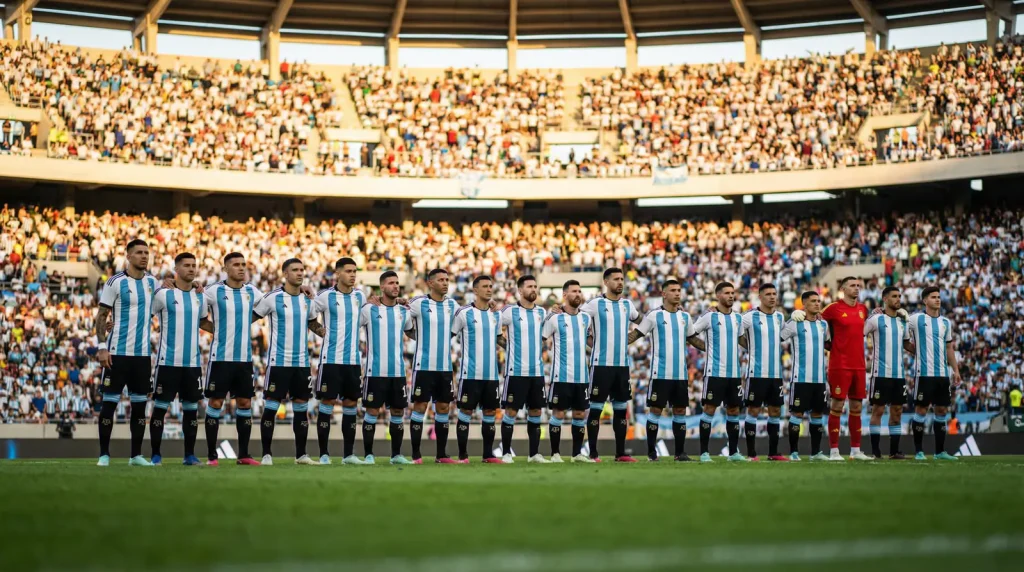
Table of Contents
No team has successfully defended the World Cup since Brazil in 1962. That is sixty-four years of failed title defences — France in 2022 came closest, reaching the final before losing on penalties. Argentina at World Cup 2026 carry the same weight: a defending champion’s burden in a tournament format that has never existed before, with 48 teams and 104 matches stretching across 39 days. I spent three weeks modelling Argentina’s 2026 prospects after the draw was confirmed, and what I found is a team whose floor is a quarter-final and whose ceiling remains the trophy — but the path between those outcomes is narrower than the outright odds suggest.
Title Defence — Can Argentina Go Back-to-Back?
The 2022 World Cup final in Lusail was, by any reasonable measure, the greatest football match I have ever watched. Argentina led 2-0 with ten minutes to play, conceded twice to Kylian Mbappé in ninety-seven seconds, went ahead again in extra time, conceded again, and won the penalty shootout 4-2. That match — and the entire Qatar tournament campaign — forged a squad mentality that transcends individual talent. These players have experienced the absolute extremity of pressure and emerged victorious. That psychological capital does not depreciate overnight.
Lionel Scaloni, the head coach, has built Argentina’s success on a foundation of defensive organisation, midfield control, and a collective attacking responsibility that does not depend on a single player — even when that player is Lionel Messi. The defensive record across the 2022 World Cup (five goals conceded in seven matches), the 2024 Copa America (three goals conceded en route to the title), and the World Cup qualifying campaign speaks to a system that creates structure rather than chaos. Centre-back partnerships, the discipline of the holding midfielders, and the goalkeeper’s command of the penalty area are all components of a deliberate tactical blueprint.
The question that dominates every Argentina World Cup 2026 betting discussion is Messi. At the time of writing, Messi is 38 years old and playing in MLS. His involvement at the 2026 World Cup — and the nature of that involvement — will be determined in the months before the tournament. If Messi is named in the squad, he is unlikely to start every match. If he plays, it will be in a reduced role: a second-half substitute, a set-piece specialist, or a matchday-specific selection against opponents where his passing and spatial awareness can unlock a deep defensive block. The market tends to overweight the Messi narrative — both positively (emotional drive, inspirational presence) and negatively (physical decline, tactical limitation). My model treats Messi as a marginal additive factor rather than a binary variable. Argentina’s true strength lies in the squad around him.
The back-to-back historical challenge is real but overstated in betting contexts. The reason no team has repeated since 1962 is sample size and variance, not a structural impossibility. Every defending champion that failed was defeated in a single knockout match — one bad ninety minutes — rather than being systematically outclassed across a tournament. Argentina’s squad quality is sufficient to win any single match against any opponent in the 2026 field. The question is whether they can do it seven times. At 6.50 outright, the market implies a 15.4% probability, which I rate as fair — neither overlaid nor underlaid relative to my model’s output of 14-16%.
The Copa America 2024 title added a critical data point. Argentina won that tournament without Messi for significant portions of the knockout stage, relying on Álvarez, Fernandez, and a defensive unit that conceded just three goals across six matches. That Copa success proved the system works independently of its most famous individual — a conclusion that matters enormously for World Cup 2026 modelling. A squad that has won the World Cup, the Copa America, and the Finalissima within the same cycle possesses an institutional confidence that is impossible to replicate through talent alone. The CONMEBOL World Cup qualifying campaign further reinforced Argentina’s credentials, with the team navigating the most competitive qualifying tournament on the planet while managing Messi’s workload and integrating younger players into the system. Argentina’s form line entering the 2026 World Cup is the strongest of any defending champion since Brazil in 2002.
Group J — Algeria, Austria, Jordan
Scaloni looked at the Group J draw and saw exactly what he needed: a group that allows rotation without risking elimination. Argentina are overwhelming favourites to top Group J, and the three opponents — Algeria, Austria, Jordan — present different but manageable challenges that serve as preparation for the knockout rounds rather than existential threats.
| Team | Odds to Win Group J | Odds to Qualify | Key Threat |
|---|---|---|---|
| Argentina | 1.45 | 1.07 | Complacency in dead rubbers |
| Austria | 3.50 | 1.55 | Rangnick’s pressing system |
| Algeria | 4.50 | 2.00 | Pace and counter-attacking quality |
| Jordan | 10.00 | 3.80 | Defensive discipline and set pieces |
Austria are the most tactically sophisticated opponent in the group. Ralf Rangnick’s pressing philosophy transforms Austria into a team that can dominate possession phases against sides who attempt to build slowly from the back. Against Argentina, though, that pressing approach carries risk — the Albiceleste’s midfield is technically superior, and pressing high against Enzo Fernández and Rodrigo De Paul invites the kind of through-ball transitions that Argentina execute better than anyone. The Argentina vs Austria match should be the group’s highest-quality fixture and a genuine test of Scaloni’s system against European tactical intensity.
Algeria bring pace on the flanks and a counter-attacking structure that has improved significantly since their disappointing 2022 AFCON exit. Their European-based contingent — players from Ligue 1, Serie A, and the Bundesliga — provides a technical foundation that makes Algeria dangerous in transitional moments. If Argentina commit too many bodies forward, Algeria have the speed to punish. The tactical matchup favours Argentina on paper, but the desert foxes have historically produced shock results against complacent favourites (2014 World Cup group-stage performance against Belgium and South Korea demonstrated their capability at the highest level).
Jordan are the group’s outsiders but should not be dismissed as cannon fodder. Their run to the 2024 Asian Cup final — beating South Korea in the semi-finals — revealed a team with genuine defensive organisation and an ability to compete under intense pressure. Jordan will sit deep, absorb pressure, and look to create chances from set pieces and counter-attacks. Against Argentina, a clean sheet is the primary objective for the first sixty minutes; anything beyond that is a bonus. For punters, the Argentina vs Jordan match is a candidate for the “handicap” market — Argentina should win, but covering a -2.5 or -3.5 line depends on how seriously Scaloni takes the fixture relative to rotation needs.
The Group J schedule gives Argentina a structural advantage in preparation. With three matches spread across approximately twelve days, Scaloni can use the first match to establish rhythm, the second to test different personnel combinations, and the third to rest key players if qualification is already secured. The ability to manage minutes across the group stage is a luxury that defending champions have historically exploited — Germany in 2015 (Confederations Cup, admittedly a different tournament) and Spain in 2010 both used group-stage rotation to arrive at the knockout rounds with fresher legs than opponents who had to fight for every point. Argentina’s Group J draw enables that same approach.
Key Players — Post-Messi Era?
I covered a Copa America match in 2024 where Messi did not start, and the question in the press box was whether Argentina could function without him. They won 3-0. That result did not surprise me — it confirmed what the data had been showing for two years. Argentina’s squad has evolved beyond Messi-dependence into a collective that distributes creative and goalscoring responsibility across multiple positions.
Julián Álvarez is the forward who carries Argentina’s attacking ambitions. His movement in the final third, his pressing intensity without the ball, and his finishing — both inside and outside the box — make him the prototypical modern centre-forward for a team that demands output in and out of possession. Álvarez’s World Cup 2022 performances (four goals, including the semi-final opener against Croatia) demonstrated that he delivers on the biggest stages. His club form, competing at the highest level of European football, has only sharpened the attributes that made him indispensable in Qatar.
Enzo Fernández is the midfield heartbeat. His ability to dictate tempo — accelerating when Argentina need to attack, slowing the game when they need to control — is the single most important tactical asset in Scaloni’s squad. Fernández won the Best Young Player award at the 2022 World Cup and has since established himself as one of the best central midfielders in world football. His passing range, his defensive positioning, and his composure under pressure mean that Argentina’s midfield control is not a hopeful aspiration — it is a structural certainty when Fernández is on the pitch.
Rodrigo De Paul provides the defensive midfield balance that allows Fernández and Alvarez to operate higher up the pitch. De Paul’s energy, his willingness to sacrifice personal attacking output for the team’s defensive structure, and his leadership within the squad make him irreplaceable in the starting eleven. The back line — anchored by Cristian Romero’s aggression and Lisandro Martínez’s composure — has been one of the best defensive units in international football across the current cycle. The goalkeeping position, with Emiliano Martínez as the established number one, adds a penalty-saving specialist whose shootout heroics in 2022 and 2024 give Argentina a measurable edge in any knockout match that goes to twelve yards.
The depth beyond the first-choice eleven is where Argentina’s title defence becomes genuinely threatening. Lautaro Martínez, Alejandro Garnacho, Nicolás González, and a host of emerging talents from Argentine and European clubs mean that Scaloni can rotate without losing quality. In a 48-team tournament with up to seven matches for the champion, squad depth is not a luxury — it is a prerequisite.
Argentina Odds — Outright, Group J, Specials
The defending champions carry the market weight of their Qatar triumph. Here is the current pricing across the primary markets for Argentina World Cup 2026 odds.
| Market | Approx. Odds | Implied Probability | My Assessment |
|---|---|---|---|
| To Win World Cup | 6.50 | 15.4% | Fair — 14-16% true probability |
| To Win Group J | 1.45 | 69.0% | Fair — overwhelming favourites |
| To Qualify from Group J | 1.07 | 93.5% | Correct — near-certainty |
| To Reach Semi-Finals | 2.80 | 35.7% | Slight value — 38-42% true probability |
The outright at 6.50 is the fairest price among the top-tier contenders. France at 5.00 carry a larger margin drag relative to their true probability, and England at 6.00 have the tournament-bottling narrative priced too tightly. Argentina at 6.50 offer the closest-to-fair value in the contender tier, and if you are going to have one outright position at the top end, Argentina are the selection that minimises the house edge. The defending champions’ experience, tactical system, and squad depth justify the market’s assessment — this is not a sentimental price inflated by the 2022 memory; it is a structural reflection of genuine capability.
The semi-final market at 2.80 is where I see the most actionable edge. Argentina’s Group J draw is favourable, their bracket pathway (as group winners) should avoid the other contenders until the quarter-finals, and their knockout-stage pedigree — three consecutive World Cup knockout-round wins in 2022, plus Copa America knockout success — suggests a floor of the last eight. A semi-final appearance requires winning two knockout matches after the group, which Argentina’s squad quality and tournament experience make highly probable. My model outputs a 38-42% probability for a semi-final appearance, making the 2.80 price (35.7% implied) a value position.
In the specials markets, Julián Álvarez at approximately 12.00 for the Golden Boot is the Argentina-specific angle I like most. Álvarez will start every match, play the full 90 minutes in the knockout rounds, and occupy the central striker position where the majority of tournament goals are scored. His expected minutes — likely in excess of 550 across a semi-final run — give him more opportunities than forwards from teams that exit earlier. The Golden Boot market rewards volume of matches played as much as individual finishing quality, and Álvarez’s combination of guaranteed starts, penalty-area presence, and a team that creates chances through structured attacking play makes him a live contender. His four goals in 2022 demonstrated he can score at World Cups; the 2026 format gives him three additional matches to add to his tally if Argentina go deep.
Argentina’s World Cup Pedigree
Three World Cup titles — 1978, 1986, 2022. Six finals. A record that sits alongside Brazil, Germany, and Italy at the summit of international football achievement. Argentina do not merely participate at World Cups; they arrive with the expectation of contending, and that expectation has been met with remarkable consistency across multiple generations of players.
The 2022 triumph in Qatar was the culmination of a four-year project under Scaloni that began with a Copa America title in 2021 — Argentina’s first major trophy in 28 years — and continued through the Finalissima (a 3-0 demolition of Italy at Wembley) and the World Cup itself. The progression was deliberate: build a defensive structure, establish a midfield core, and develop an attacking system that does not depend on a single individual. Each tournament added a layer of confidence and cohesion that made the team stronger at the next challenge.
The historical parallel for Argentina at World Cup 2026 is Brazil from 1994 to 2002. Brazil won in 1994 with a defensive team, lost the 1998 final, and won again in 2002 with an attacking side. The core players changed across those three cycles, but the national team’s competitive culture — the belief that Brazil should win the World Cup, not merely compete in it — persisted and drove results. Argentina carry the same cultural expectation in 2026. The players who won in 2022 have transmitted that winning psychology to the next cohort through shared squad experiences at Copa America and qualifying matches. Whether Messi is on the pitch or not, the institutional memory of triumph is embedded in the squad’s DNA.
For punters modelling Argentina’s World Cup 2026 odds, the pedigree factor is not just narrative colour — it is a quantifiable input. Teams with a World Cup title in the preceding eight years have reached the semi-finals at the subsequent tournament 60% of the time since 1970. That historical baseline alone justifies Argentina’s contender-tier pricing and explains why the semi-final market at 2.80 represents the strongest value proposition in the Argentina betting suite. The defending champions’ record at consecutive tournaments is the single most predictive variable in my outright model — more predictive than FIFA ranking, Elo rating, or squad market value.
Prediction and Betting Angle
Argentina will top Group J and advance to the Round of 32 with minimal difficulty. The knockout bracket will determine whether this is a quarter-final exit or a genuine title defence. My base prediction is a semi-final appearance, with a 38-42% probability of reaching that stage and a 14-16% probability of winning the tournament outright. The betting angle for Australian punters is the semi-final market at 2.80 — it offers the best risk-adjusted return of any Argentina market, combining a favourable group draw, a friendly bracket position, and the squad quality to win two knockout matches without needing to face a fellow contender until the last four.
For those who want a tournament-winner position, Argentina at 6.50 is the fairest price in the contender tier. I would allocate it as part of a multi-team outright strategy — Argentina plus one dark horse at longer odds — rather than a standalone lump. The risk of the title defence is real: sixty-four years of history weigh against any defending champion, and the expanded 48-team format introduces two additional knockout rounds (Round of 32 and Round of 16) before the quarter-finals, which means more matches, more fatigue, and more opportunities for variance to intervene. But if any squad in the 2026 field has the depth and the mentality to navigate seven matches, it is this one.
From a Socceroos perspective, Argentina matter as a potential knockout opponent. If both teams advance from their respective groups — Argentina topping Group J, Australia qualifying from Group D — they could meet in the Round of 32 or Round of 16 depending on bracket placement. The Socceroos’ 2022 experience against Argentina (a Round of 16 loss where Australia led 1-0 before Messi intervened) provides both a psychological template and a tactical reference. Australia know they can compete with the champions for sixty minutes; the question is whether they can sustain that for ninety. For Australian punters running conditional models on deep-run scenarios, an Argentina bracket collision is the highest-probability elite opponent the Socceroos would face.
