
Estadio Azteca — World Cup 2026 Opening Match Venue & Guide
 Available in US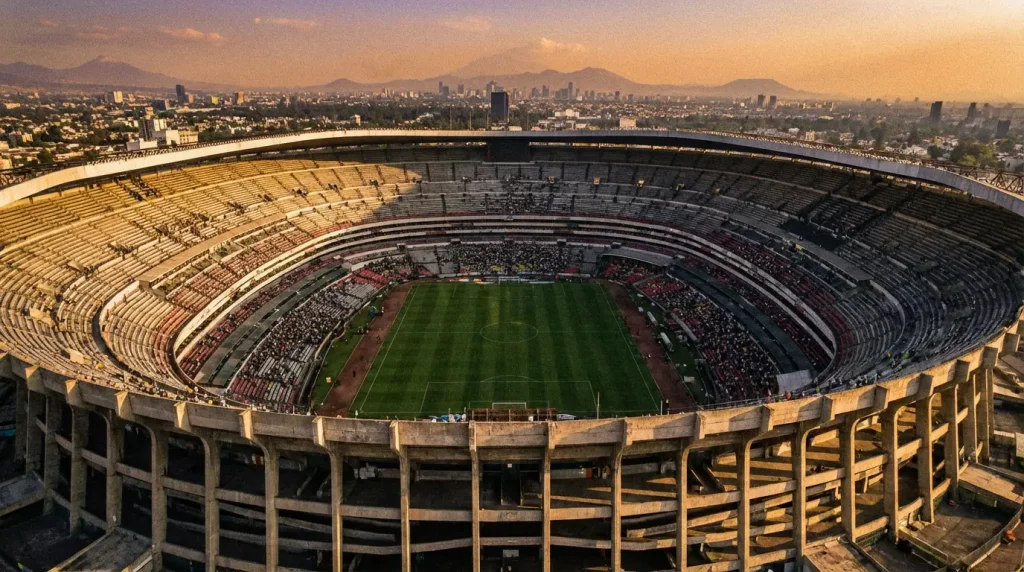
Table of Contents
Diego Maradona’s “Hand of God.” His solo run past five England defenders moments later. Pelé lifting the Jules Rimet trophy in 1970 after Brazil’s 4-1 demolition of Italy. These are not just football memories — they are moments embedded in the DNA of Estadio Azteca, and on 11 June 2026, this cathedral of the game hosts the opening match of the FIFA World Cup for an unprecedented third time. No other stadium on earth has staged two World Cup finals, let alone three opening ceremonies. Mexico vs South Africa kicks off the 2026 tournament on a pitch where the altitude, the atmosphere, and the history conspire to produce the kind of spectacle that defines careers. For Australian punters, the Azteca is not hosting any Socceroos fixtures, but its role as the tournament’s curtain-raiser sets the market tone for every group that follows.
Stadium at a Glance
Estadio Azteca opened on 29 May 1966 — sixty years ago — and it has witnessed more significant football matches than any venue on the planet. The original capacity exceeded 114,000 for the 1970 World Cup final, though extensive renovations and modern safety regulations have reduced it to approximately 83,000 in the current FIFA configuration. The stadium sits in the Coyoacán district of southern Mexico City at an altitude of 2,200 metres above sea level, a physiological detail that has shaped the outcome of matches played here for six decades.
| Detail | Information |
|---|---|
| Full Name | Estadio Azteca |
| Location | Coyoacán, Mexico City, Mexico |
| Opened | May 1966 |
| Capacity (FIFA configuration) | Approximately 83,000 |
| Altitude | 2,200 metres above sea level |
| Surface | Natural grass (hybrid reinforced) |
| Roof | Open-air |
| Primary Tenant | Club America (Liga MX), Mexico national team |
| World Cup History | 1970 (final), 1986 (final), 2026 (opening match) |
The altitude is the variable that separates Azteca from every other World Cup venue. At 2,200 metres, the air contains roughly 20% less oxygen than at sea level, and the reduced air resistance causes the ball to travel faster and with less predictable flight. Teams accustomed to playing at altitude — Mexico, Colombian clubs, Bolivian sides — hold a measurable advantage over opponents whose preparation has been entirely at sea level. Visiting European teams have historically struggled in the opening 30 minutes at Azteca as their bodies adjust to the reduced oxygen availability, and that period of vulnerability creates a specific betting opportunity in first-half markets.
The stadium underwent significant renovations between 2016 and 2024 to meet FIFA’s infrastructure requirements for 2026. The upgrades included new seating throughout the lower bowl, modernised broadcast facilities, improved disability access, enhanced floodlighting, and structural reinforcement of the upper tiers. The pitch surface uses a hybrid grass system — natural turf reinforced with synthetic fibres — that provides consistent playing characteristics even during Mexico City’s June rainy season, when afternoon thunderstorms can dump 20-30mm of rain in under an hour.
Opening Match — Mexico vs South Africa, 11 June
The 2026 World Cup begins with Mexico hosting South Africa at Estadio Azteca on the evening of 11 June. The symmetry with history is deliberate — Mexico hosted the opening match at the 1970 World Cup (Mexico 0-0 Uruguay) and the 1986 World Cup (Mexico 1-1 Bulgaria), and both of those openers ended in draws. If you believe in the weight of history shaping tournament narratives, the draw at approximately 3.40 for Mexico vs South Africa carries an almost poetic logic.
Mexico will approach this match with the pressure of 83,000 home fans and the knowledge that their recent World Cup record is modest — group-stage exits in 2018 and 2022 after promising starts. The “fifth match curse” narrative, referring to Mexico’s failure to progress beyond the round of 16 at seven consecutive World Cups, looms over every match they play. South Africa, competing in a World Cup for the first time since hosting in 2010, bring a squad that qualified through a competitive CAF campaign but lack the star power of the continent’s traditional forces. Their qualification was built on defensive organisation and clinical counter-attacking, which is a template that can frustrate hosts in tournament openers where the crowd’s expectations create as much pressure as the opposition.
The altitude factor adds a specific edge to this fixture. Mexico train and play regularly at Azteca’s altitude; South Africa, based primarily in Johannesburg at 1,750 metres, are partially acclimatised but not fully adjusted to the additional 450 metres. That altitude differential is smaller than it would be for a European or Asian team, which reduces Mexico’s physiological advantage. The match profiles as a narrow Mexican victory — 1-0 or 2-1 — with the head-to-head market pricing Mexico at around 1.65, the draw at 3.40, and South Africa at 5.50. I lean towards Mexico, but the value play is the under 2.5 goals market at approximately 1.80, driven by tournament-opener caution and South Africa’s defensive approach.
All Matches at Estadio Azteca
Mexico’s three World Cup venues — Estadio Azteca in Mexico City, Estadio BBVA in Monterrey, and Estadio Akron in Guadalajara — share 13 matches across the tournament. Azteca, as the flagship, receives the largest allocation including the opening match, additional Group A fixtures, and potentially a Round of 32 match. The exact breakdown beyond the opening fixture depends on FIFA’s final scheduling, but Azteca’s status as the ceremonial heart of the Mexican leg of the tournament is confirmed.
Group A fixtures at Azteca will feature Mexico’s group opponents — South Korea, South Africa, and Czechia — in various combinations. The altitude variable applies equally to all visiting teams, and for punters assessing these fixtures, the physiological data is clear: teams from low-altitude nations (South Korea from near sea level, Czechia from 200 metres) face a more significant adjustment than South Africa from 1,750 metres. First-half markets at Azteca consistently favour the home side or the team better adapted to altitude, and this trend extends beyond Mexico’s own matches to any fixture hosted in the thin air of Mexico City.
The knockout-round fixture at Azteca, if confirmed, would carry the same altitude premium. A Round of 32 match between a sea-level European team and a South American side accustomed to playing at elevation could see the altitude factor influence the outcome more than squad quality. This is precisely the kind of venue-specific edge that sharp punters should integrate into their match analysis — it does not appear in standard ratings models, but it shows up in the results.
Azteca’s World Cup Heritage — 1970, 1986, 2026
The weight of history at Estadio Azteca is not abstract — it is carved into the concrete and woven into the fabric of every match played here. In 1970, Brazil’s legendary squad featuring Pelé, Jairzinho, Tostão, and Gérson played three group matches and the final at Azteca, producing some of the most beautiful football ever recorded on film. The 4-1 victory over Italy in the 1970 final remains the benchmark for World Cup performances, and the Azteca crowd’s reaction to Brazil’s fourth goal — Carlos Alberto’s sweeping team move finished from 20 metres — is embedded in the collective memory of the sport.
Sixteen years later, the same stadium hosted Maradona’s defining moments. The 1986 quarter-final between Argentina and England produced two of the most famous goals in football history within four minutes of each other — the controversial handball and the solo masterpiece that saw Maradona beat five defenders from inside his own half. The 1986 final, also at Azteca, saw Argentina defeat West Germany 3-2 in a match that swung wildly in both directions. These moments are not just sporting events — they are cultural touchstones that give Azteca an emotional resonance no other World Cup venue can match.
In 2026, Estadio Azteca becomes the only stadium to host matches at three separate FIFA World Cups. That distinction carries commercial value — FIFA’s marketing of the opening ceremony will lean heavily on the heritage angle — and atmospheric significance. The crowd at Azteca on 11 June will not merely be watching a football match; they will be participating in a tradition that stretches back over half a century. For punters, this context matters because it amplifies the home-crowd effect beyond normal levels. Mexico’s record at Azteca in competitive matches is formidable — they have lost just three home World Cup qualifiers since 2000 — and the tournament opener will carry even greater emotional intensity than a standard qualifier.
Mexico City — Essentials
Mexico City is one of the world’s great metropolises — 22 million people, world-class cuisine, a cultural depth that rivals any capital on the planet, and a chaotic energy that can overwhelm first-time visitors. Getting to Mexico City from Australia requires a connection, typically through Los Angeles, Dallas, or Houston. Flight time from Sydney to Mexico City via LA runs approximately 18-20 hours total, and the time difference is 15 hours behind AEST during the World Cup (Central Daylight Time, UTC-5).
Estadio Azteca sits in the south of the city, accessible via the Metro Linea 2 (blue line) to the Tasquena station, followed by the Xochimilco light rail to the Estadio Azteca stop. The journey from the city centre takes 45-60 minutes by public transport and considerably longer by car during Mexico City’s notorious traffic congestion. Match days at Azteca generate traffic that paralyses surrounding streets for hours before and after kick-off, so public transport or walking from a nearby hotel is strongly recommended.
Accommodation ranges widely — from budget hostels in Roma Norte at A$40 per night to luxury hotels in Polanco at A$500+. The neighbourhoods of Condesa and Roma, roughly 12 kilometres north of the stadium, offer the best combination of atmosphere, restaurants, safety, and transport links for visiting fans. Mexico City’s altitude of 2,200 metres affects visitors as well as players — expect mild breathlessness during physical exertion for the first 48 hours, and drink significantly more water than you would at sea level. The city’s June weather is warm (20-26 degrees Celsius) with afternoon rain showers that pass quickly, so pack a light waterproof jacket alongside your Socceroos scarf.
